 Gemini_Generated_Image_8d6xdw8d6xdw8d6x_%282%29.png
Key Takeaways
- Resume parsing is automated text extraction — software reads your CV and converts it into structured data before any human sees it.
- NLP and machine learning power modern parsers — systems have advanced significantly beyond simple keyword matching.
- Parsing happens the moment you upload your CV — most applicant tracking systems run parsing automatically on submission.
- Poor formatting breaks parsers — columns, graphics, and non-standard fonts cause data to be scrambled or lost.
- Parsed data determines your ranking — if the parser misreads your experience or skips a skill, your match score drops.
- Candidates can use parsing tools too — tools designed for job seekers show exactly how a recruiter's system will read your CV.
- In 2025, average applications per vacancy hit nearly 49 — a 286% increase from the previous year, making parsing indispensable at scale.
What Resume Parsing Actually Means
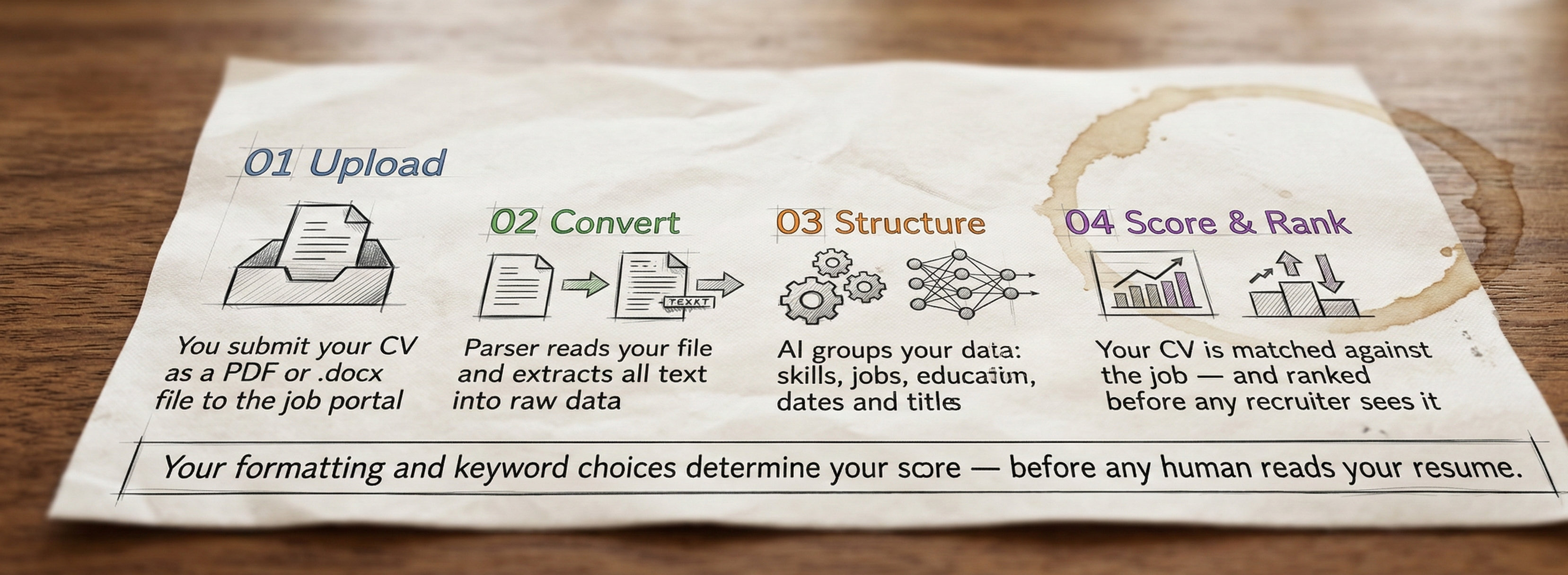
Resume parsing is the process of using software to automatically extract structured information from a CV or resume. The moment you click "Apply" and upload your document, a parser goes to work — pulling out your name, contact information, work history, job titles, dates of employment, education, skills, and certifications. It then organizes all of that information into a database record the recruiter can view, search, and compare.
What you see as a beautifully designed document, the parser sees as raw text to be dissected. The visual presentation — fonts, spacing, design — is largely irrelevant to the system. What matters is whether the text is machine-readable and whether the information is logically organized.
Understanding how this works from the inside is one of the most useful things you can do as a job seeker, because it explains why resumes that look great often perform poorly in recruitment systems.
How Resume Parsers Work Step by Step
Document Conversion
Before any analysis can happen, the parser must convert your file into readable text. PDFs, Word documents, and other formats are processed differently. For text-based PDFs and .docx files, this conversion is straightforward — the parser lifts text directly. For image-based or scanned files, Optical Character Recognition (OCR) is required, and the accuracy rate drops significantly.
This is why submitting a scanned resume or an image-based PDF often results in your CV being parsed incorrectly or not at all.
Text Extraction and Section Recognition
The parser identifies sections of your resume using a combination of header detection and positional analysis. When it sees "Work Experience" or "Education," it flags that section and applies the correct extraction logic — pulling job titles and dates from one section, degree names from another.
This is why standard section headers matter. If you've labeled your skills section "My Toolkit" or "What I Know," the parser may misclassify that content entirely, burying skills that should be driving your match score.
Entity Recognition and Data Structuring
Modern parsers use Natural Language Processing (NLP) to identify specific entities within your text. NLP models are trained to recognize patterns — so "Senior Software Engineer at Acme Corp | 2021–2024" gets broken into: Job Title = Senior Software Engineer, Employer = Acme Corp, Dates = 2021–2024.
This structured output is what feeds into the Applicant Tracking System. Your entire CV becomes a database record — searchable, sortable, and rankable against the job description's requirements.
 12.webp
Matching and Scoring
Once parsed, your data is compared against the job requirements to generate a match score. The ATS checks whether the skills, job titles, years of experience, and qualifications extracted from your CV align with what the employer specified.
The score determines your position in the applicant queue. Higher-scoring candidates appear first in the recruiter's dashboard. Candidates who score below the employer's threshold may be automatically filtered out before a human ever sees the application.
What Parsing Can and Cannot Handle
Understanding the limits of parsing helps you format your resume strategically:
| Format or Element | Parser Handles It | Risk | | ---------------------------- | ------------------- | ----------- | | Text-based PDF | Yes | Low | | .docx (Word document) | Yes | Low | | Scanned or image PDF | Partial (OCR) | Medium-High | | Single-column layout | Yes | Low | | Multi-column or table layout | Inconsistent | High | | Standard section headers | Yes | Low | | Creative or renamed headers | Often misclassified | High | | Embedded graphics or icons | Skipped | High | | Hyperlinks | Usually extracted | Low | | Custom or decorative fonts | Unpredictable | Medium |
The most dangerous resume elements are those that look professional to a human but break machine-readable structure. Multi-column designs — common in modern resume templates — frequently cause the parser to read across columns instead of down each one, resulting in scrambled job titles, mixed-up dates, and missing content.
Why This Matters More Than Ever
The average number of applications per job vacancy reached nearly 49 in 2025 — a 286% increase from the previous year. At that volume, manual screening is simply not possible. Resume parsing technology isn't a convenience; it's the only mechanism that makes hiring function at this scale.
For candidates, this shift has a concrete implication: the machine reads your resume before any person does. Being good at your job is table stakes — getting your CV through the parser is the prerequisite to being evaluated at all.
Using an ATS-optimized CV builder ensures that the document you submit is structured in a way parsers can handle cleanly, regardless of how sophisticated or outdated the employer's system is.
How Candidates Can Use Parsing to Their Advantage
Most guides on resume parsing are written for recruiters. But candidates benefit just as much from understanding the system — and increasingly, tools designed specifically for job seekers make parsing work for them, not against them.
Hiris functions as a candidate-side parsing engine. When you upload your existing CV, the platform extracts and structures your career history — job titles, achievements, skills, dates — into a master profile. When you paste a job description, Hiris analyzes what the recruiter's ATS is likely looking for and generates a tailored resume optimized for that specific posting.
The AI CV tailoring tool essentially inverts the parsing process: instead of hoping your resume survives a recruiter's system, it builds a document designed from the ground up to score well in it.
 12.webp
The Candidate-Facing Reality
Parsing is invisible to most applicants — and that's the problem. You submit your resume, hear nothing back, and assume you weren't qualified enough. In many cases, the real issue is that the parser couldn't read your document correctly, or your skills were named differently from the job description's exact phrasing.
Fixing a parsing problem is not complicated once you know it exists: use a text-based .docx or PDF, stick to a single-column layout, use standard section headers, mirror the exact language from the job description, and verify your resume is text-selectable before submitting.
Understanding what resume parsing is — and how it shapes every application you make — is one of the most practical shifts you can make in your job search strategy.
Sources:
What is Resume Parsing? A Complete Guide for HR Teams – Senseloaf
What Is Automated Resume Parsing and How Does It Work in 2025 – Mokahr
Resume Parsing: What It Is and How It Transforms Recruitment – Mokahr
What is Resume Parsing and Why You Should Be Using It – SmartRecruiters
Resume Parsing Software: Recruiter's Complete Guide – RecruitCRM